
Morning · Dương Đông · 15 km north
Duong Dong Market: Breakfast Where Phú Quốc Shops
Duong Dong market is Phú Quốc’s biggest day market — and the place where the island actually wakes up. From five in the morning, boats tie up along the Dương Đông river, mackerel and crab come off the decks still dripping, and half the town arrives before the sun does. If the night market is Phú Quốc’s stage, the day market is its backstage: fewer lanterns, more life.
Don’t confuse it with the Phú Quốc night market on Bạch Đằng street — that’s the evening event. Duong Dong market works by daylight on the riverbank, entered from Trần Phú street, about 15 km north of Bãi Trường. Morning is the only time that really counts.
What Duong Dong market is (and why mornings matter)
The market splits into three sections, best walked in this order.
The seafood section sits closest to the river and is the loudest and most worth seeing. Mackerel, grouper, cobia, blue crab, squid, tiger prawns — most of it landed overnight, some of it still splashing in basins. You don’t need to buy anything; watching housewives and restaurant cooks negotiate is half the reason to come.
The dried-goods section runs through the middle: dried shrimp, dried squid, and cá thiều — the dried fish locals shred and dip in chilli sauce. Everything here keeps well, which makes it the practical souvenir aisle.
The specialty stalls cluster near the exits: fish sauce, Phú Quốc pepper, sim wine, honey, fish cake. The same products exist in the tourist zones at different prices — here you pay what the town pays.
The best window
The market runs roughly 5 am to 7 pm daily, but its true rhythm is 6 to 9 am: fullest stalls, hottest food, coolest air. After nine it thins out and the sun turns serious — by then you should already be sitting over a bowl of bánh canh.
Breakfast at Duong Dong market: what to order
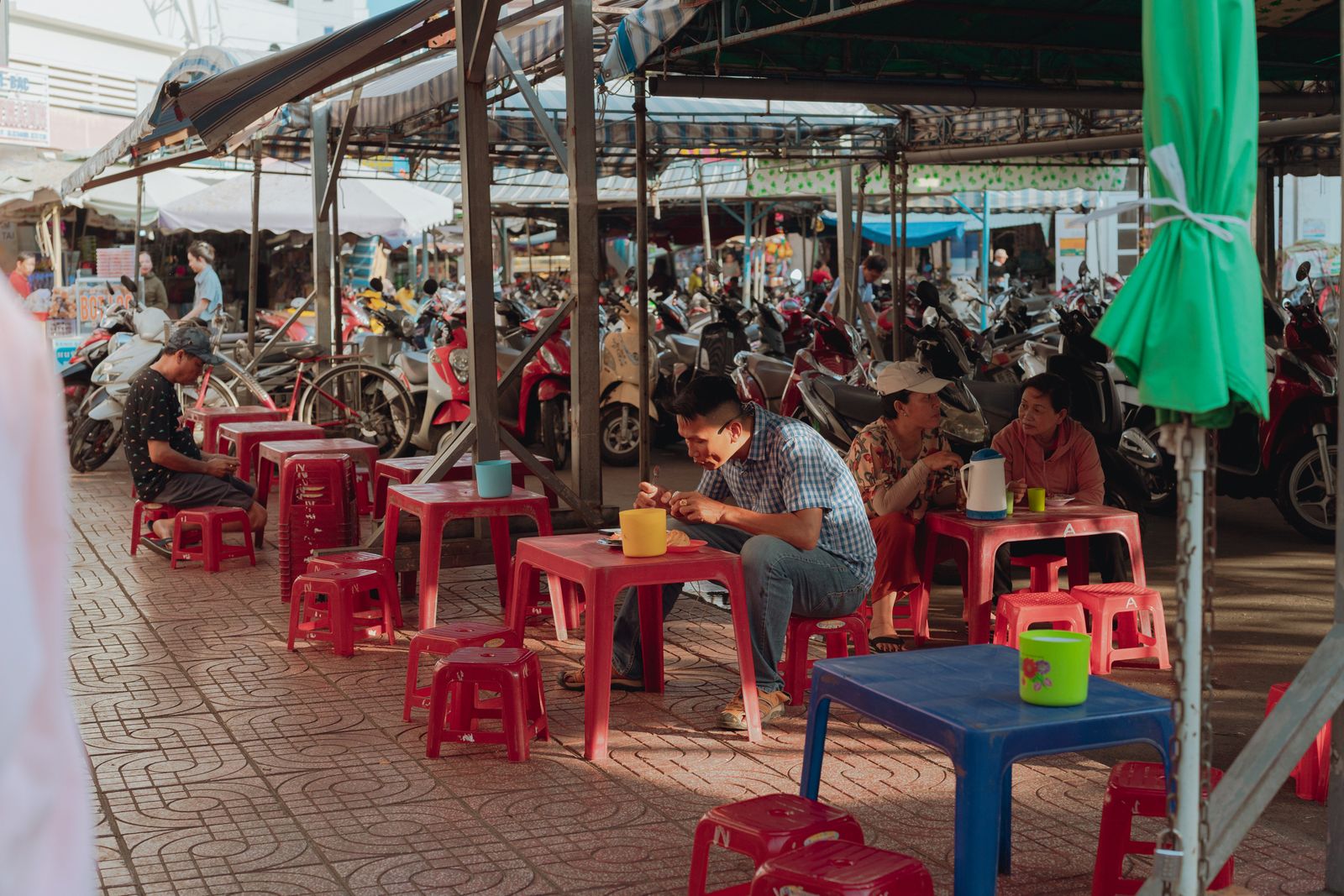
Visiting the market without eating there is doing half the trip. The food stalls gather around the entrances — plastic stools, steaming broth pots, and a seat that’s never empty for long.
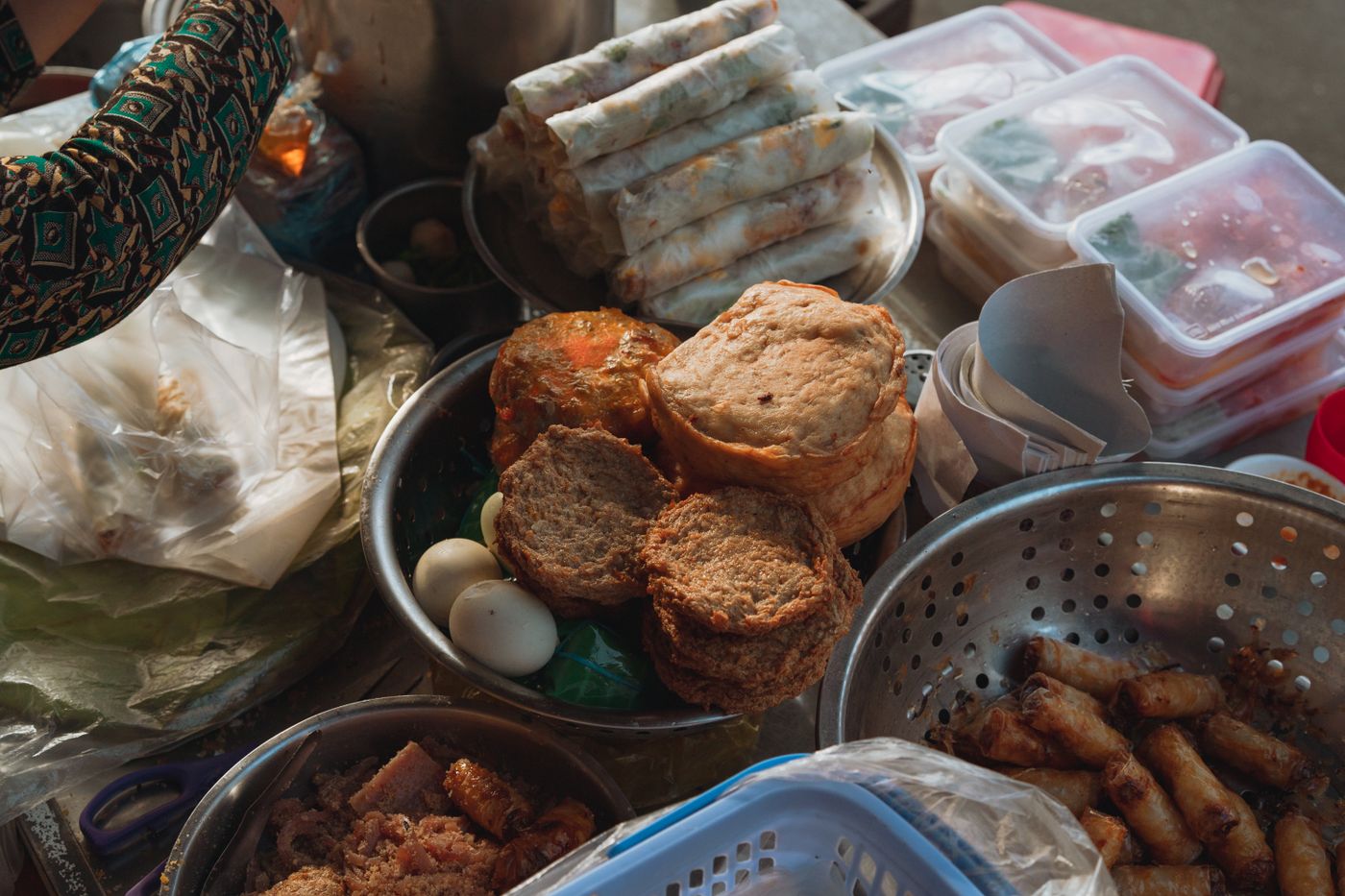
Fried chả cá, rice-paper rolls, quail eggs — laid out early, usually gone before noon.
Bánh canh ghẹ is the order to make: thick rice noodles in a broth sweetened by crab shells and roe, with picked crab meat on top. Hủ tiếu hải sản is the lighter option — the prawns and squid come from the stalls a few metres away.
Hot fried chả cá (fish cake) sells by weight near the gates — buy a small bag, dip it in chilli sauce, eat it walking. And bánh tét mật cật — sticky rice cake wrapped in the fan-palm leaves found only on this island — is the thing to carry home for the road.
If you’d rather sit down properly, the island’s two most famous noodle breakfasts are both within walking distance of the market: bún quậy and bún kèn. Prices around the market are market prices, not beach-strip prices.
What to take home
Four things worth the suitcase space, in order of how easy they travel:
- Phú Quốc pepper — light, fragrant, keeps for a year. Look for evenly coloured whole peppercorns with a sharp smell.
- Dried seafood — dried shrimp, dried squid, cá thiều. Stalls will vacuum-seal it if you ask.
- Sim wine — a small bottle makes the right gift.
- Fish sauce — the island’s most famous product and the hardest to carry: airlines don’t allow it in cabin luggage, so have the stall box it for checked baggage. The regular stalls do this every day.
One old rule that still holds: walk a full loop comparing prices before you buy, favour fixed stalls with name boards, and check the goods before they’re packed.
Getting there from Bãi Trường
From SS27 Sonasea, ride the coast road north for about 20 minutes by scooter; a Grab takes around 25 minutes and costs 90,000–130,000 VND one way. Leaving before 7 am means cooler air and easier parking.
Three small things: bring cash in small notes (the stalls barely take cards), wear sandals rather than shoes — the seafood section floor is permanently wet — and keep your bag in front of you in the crowd.
A morning that works
Leave Luna at 6:30 and arrive while the seafood section is at full volume. Walk the loop, eat at 7:45, buy some pepper and dried squid. On the way out, stop at Dinh Cậu at the river mouth — a few minutes’ walk from the market. You’re back on Bãi Trường before 10, in the pool before the heat peaks. Still curious after dark? Return to the same block in the evening — that’s when the night market takes over.
At Luna Oriental, we point guests to Duong Dong market the way we’d point a friend: go early, eat at the stalls, haggle with a smile. Our 18 rooms sit on Bãi Trường, close enough that a market morning still leaves you a full beach day — and booking direct with us always beats the OTA price.
Photos: Theodore Nguyen on Pexels.
Frequently asked questions
Is Duong Dong market the same as the Phú Quốc night market?
No. The night market runs along Bạch Đằng street from about 6 pm; Duong Dong market is the island's main day market by the river nearby, busiest from 6 to 9 in the morning. They're a few minutes' walk apart and completely different worlds.
What time does Duong Dong market open?
Roughly 5 am to 7 pm daily, but the real window is 6–9 am, when the seafood has just landed and the food stalls are at their best. Arrive before 8 to see the market at its own pace.
How far is Duong Dong market from Bãi Trường?
About 15 km north of SS27 Sonasea on Bãi Trường — around 20 minutes by scooter or 25 by Grab, typically 90,000–130,000 VND one way. The front desk at Luna Oriental can book a car the evening before if you want an early start.